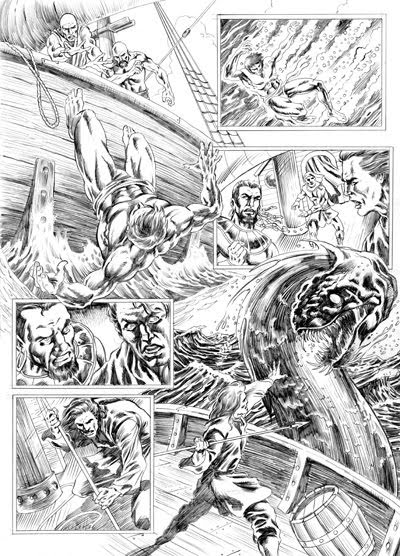
This week's interview is with Daniel Panero, whose work you may know from Crystal Fractal Comics, Skipper Martin's Bizarre New World, and a host of other wonderful projects.
  DC: What kind of comics did you read as a kid growing up in Spain? Here, in Canada, when I was a kid, comics were available at every corner variety store. Going to the local store with a pocket full of quarters (and maybe a few dollar bills) was one of my favourite experiences. I never knew what treasures I'd find on the spinner rack. How available were comics when you were growing up?
DB: My introduction to comics were stories based on Disney characters. I remember reading as a little kid a weekly magazine called "Don Mickey" which included several stories in every issue. My mom used to buy me those. Interestingly enough, those comics were not produced in the USA, but the text and art came from Italy. They are still very popular there.
I discovered superheroes when I was about nine. I was sick at home one day and my dad brought me a bunch of magazines, amongst which there was a Superman issue drawn by Jerry Ordway. His art had a great impact on me and opened the door to a whole new world of creativity. Soon afterwards I became a hardcore fan. I used to buy comics at the news stand on the way home from school (weeks seemed endless, then, waiting for the next issue to arrive) . I would also go to a flea market on Saturdays to buy old issues and later on I discovered the only comic book store in my town. I consider myself lucky because back then in Spain there was already a very good variety of titles to choose from, and the comic book market in Spain was very active, both with national and imported titles. Marvel and DC comics were my favourites. I read a lot of Superman, Batman, Iron Man, Spiderman and Daredevil. I liked the Fantastic Four too.
DC: What was your first break as an artist? Did you begin by producing independent comics or illustrating stories for small press publishers? DB: I used to collaborate on fanzines during my high school years. While I was in college I published several strips in a couple of national newspapers, and that was my first professionally published job. Since then I have been working as an illustrator for magazines, books and advertising companies.
 DC: You have a very realistic and fluid style of illustration. Who were your influences...not just in comics but in any form of art?
DB: Thank you very much. I have always liked the type of art that is able to bring a sense of realism into the narrative. By realism I do not mean a photographic approach to the work, but the ability to make the reader believe the world he is brought in. In my opinion, artists will achieve that goal more successfully if they have a whole, academic artistic formation prior to their work in comics. Some of the artists in the comic book field whose work I admire and has influenced me (not that I am even close to them) are, in a random order, Alex Raymond, Wally Wood, Gene Colan, Bernie Wrightson, John Buscema and Al Williamson. Let me also name Alfredo Alcalá, probably the most underrated comic artist ever.
In terms of influences from other art fields I would mention the paintings from the Renaissance masters, particularly Leonardo and Michelangelo, who shaped the pattern of Western art for centuries to come, with their methodic, almost scientific, approach to the issue of representation of reality. As far as of subjects, though, I like the paintings of the Romantic period (1800s) better, particularly those sublimating historical facts, or depicting myths and far lands.
DC: You've lived in Europe and North America...how would you compare and contrast each continent’s “comics scene”? DB: When we refer to the European comics scene we are basically talking about the French and Belgian publications. They have a well-established market, several publishing companies and sell a huge amount of "albums" (large, hardcover comics) every year. The most successful ones are translated and sold in other countries too. In Italy there is a stable but small comic industry, but most aspiring artists have to look abroad (France) to develop their careers. There are a lot of Italian and Spanish artists now working in French titles.
In terms of sales, I think the European numbers are small in comparison to those in North America. Comics, as an industry, are a genuine form of American art. In Europe there was no "Golden Age" of comics in the 30's. The two World Wars did not allow much space for, basically, kids' entertainment. Also, Europe is divided into countries with different tastes and different languages. There was never a huge base of potential buyers as there is in the United States. Nowadays, maybe for that reason, comics in the old continent have an aura of elitism. In terms of prices, for example, most albums are over $15, and there are no paperback editions. For a kid in Europe it would be easier (and usually cheaper) to stick to American or Japanese imported comics, rather than buy local ones (with the exception, maybe, of some very popular albums, usually humor ones). That is why the average European albums' reader is a little bit older than the average American comic book reader, (if we do not take into account hardcore collectors in this last case).
Although the American comic scene, overall, is more appealing to me, there are also interesting features in the European one. My perception is that in Europe there is a wider variety of genres, whereas in the United States, for example, superheroes have a huge part (maybe too big) of the share. I do like superheroes, though, but I also think that there are other types of stories worth writing about. I think the work Crystal Fractal is doing is wonderful because it is bringing the best of two different schools together.
DC: I've also enjoyed the wide variety of genres and characters in the Crystal Fractal Universe. I think it leads to great opportunities to tell fun stories. Do you have any favourite characters or moments in your Crystal Fractal projects? DB: I definitely like the character of Natanael de Velásquez, a.k.a. Dr. Twilight. He's cunning, and charismatic. I would like to learn more about his background and maybe see him in action.
 DC: Can you describe your process and walk us through the way things unfold after you receive a script? And also...are you a fan of full scripts with dense explanations or do you prefer some leeway to add your own interpretations to the story?
DB: I read the script a couple of times and I just focus on getting myself into the tone of the story; I try to visualize the scenes in my mind as if it was a live action movie. I then layout the thumbnails of every page on 6 inch long sheets. I can't draw too many details here, obviously, but it is extremely helpful in order to organize the structure of the final art. I try to look at the page as a whole, not as a series of unconnected panels put together. At this stage I also decide which is the best shot or angle to use in every panel (if not specified by the writer), their size and also their shape. I like to play with borderless panels, or panels within other panels. As soon as the editor approves the thumbnails, I draw every page on A3 regular sheets. I barely use the eraser, as I prefer to correct my mistakes by tracing the drawing again into another paper. Sometimes I would end up with with five or six versions of the same figure, on different papers. I prefer this system because it allows me to keep a vision of the whole thing, instead of focusing on just details. When I am happy with the results I use the lightbox to trace the art into good cardboard, and the art is ready for inking.
As for your other question, I like annotations from the writer because they help me to understand what his vision of the story is. However, I do also believe that a good artist will give his best when left with some freedom to make certain stylistic decisions, for example when it comes to choose the size of the panels, what type of shot to use, etc. When there is good coordination and mutual trust between the artist and the writer the results can be great.
DC: In what ways have your process and style evolved over the years?DB: I have gotten more familiar with the different techniques by a process of trial and error. I have also gone from copying drawings from my favorite artists to using my own personal style. The experience is much more enriching and, as I said before, allows you to understand and enjoy the process of creating comics on more than just one level.
DC: I noticed that you also have a separate website for your non-comic illustration. There are very impressive pieces there. Can you tell me about some of your experiences with your other, non-sequential work? For example, are they all painted or are some of them computer coloured? Where have these illustrations appeared?DB: Thank you! Most of the work you see there has been commissioned by an editor and published afterwards. The predominant tool I use for those illustrations is the computer and peripheral devices such as the digital tablet and the scanner. I use technology mostly for coloring and editing, but I still find it easier to draw with pen and paper (which I later scan) in the old fashioned way . Having your work in a digital format comes is very handy when they request changes to the size of the image, the colors and other types of details. This happens quite often with publishers. Some of the work you would see on my website are illustrations for children's books and magazines. These, together with work for advertising companies, represents 90% of the needs of the illustration market. Most illustrators, statistically speaking, make a living out of these. I have also done some work in the field of historical illustration. It is a very interesting field and it gave me the chance to learn more about history while working. This type of illustration requires a lot of research and it is targeted to a very critical audience, but I enjoy doing it. Finally you can also find on my website some samples of illustrations done with traditional techniques like watercolors and oils. In terms of market, they are more difficult to place, but very rewarding as a way to develop and improve your skills as an artist.
 DC: Do you attend many conventions as a professional or a fan?
DB: I have never attended conventions as a professional, but as a fan I have been to several in Spain, Italy and France.
DC: As a writer, I find music very distracting when I'm trying to work. I can't stop myself from listening to the words, and it throws me off. Even instrumental music disrupts my concentration. TV in the background is even worse! What about you...do you enjoy having music (or anything else) in the background as you illustrate a story? DB: I agree with you. I can't bear any distraction while I am dealing with the most creative part of the process, which is for me laying down the thumbnails and deciding how the page will look. However, I enjoy listening to music on my headphones while I am working on finishing my pencils or while inking. I also like sometimes to listen to radio programs. As for the TV, I chose to live without it a couple of years ago and it is a decision I have never regretted.
DC: What advice would you give aspiring illustrators or comic book artists? DB: Have you ever heard the sentence "art is 10% inspiration and 90% perspiration"? I agree with it in the sense that what makes a difference in the long term between two aspiring artists is the amount of work and dedication one puts into his job. Another piece of advice I would give is to develop your own artistic tastes. You can achieve that by studying other artists' styles, by doing some research on inspiring figures from the past. You could read books about art, go to museums or look for information online. Too many kids only find inspiration from the “hot artist” of the moment whose work has just appeared in the last months. That is fine, but it should not be your only reference. As an anecdote, an editor from one of the two largest comic book publishers in the United States once told me during an interview that none of the aspiring artists who came to him knew who Harold Foster was. Additionally, some editors at his company also lacked that knowledge. I found that very sad and surprising.
DC: Daniel, thank you very much for your time and insightful comments. I'm looking forward to following along with your work in the future. And speaking of the future...do you have any upcoming projects you'd like to promote? Thank you, Dino. It has been my pleasure. As for my upcoming projects, I am interested in developing a personal project based on historical events from ancient times. I would also be happy to adapt some classic literary works, but I am too busy right now to do so.
Check out Daniel’s website at: http://www.danielpanero.com